Our 2011 CSA began on Tuesday, the first day with sun in a while. I have heard we are nearing the end of a La Niña cycle, which would explain the colder, wetter temperatures we have be experiencing. We were thankfully still able to fill our members' baskets with various shades of green vegetation, and I think we are all looking forward to when the weather allows a more colorful harvest.
CSA set-up inside the garden shed.
New hoophouse, housing multiple varieties of tomatoes and a trellising system inside.
We completed building a new hoophouse a couple weeks ago, intended to keep heat-loving crops (tomatoes and peppers) happy and hopefully encourage them to produce fruit earlier in the season. The construction process was a learning process, to say the least.
Entrance to one of the two hives. Note the pollen being carried inside by the middle bee.
Our resident honeybees have been busy building as well, as evidenced by the constant traffic in and out of the hives.


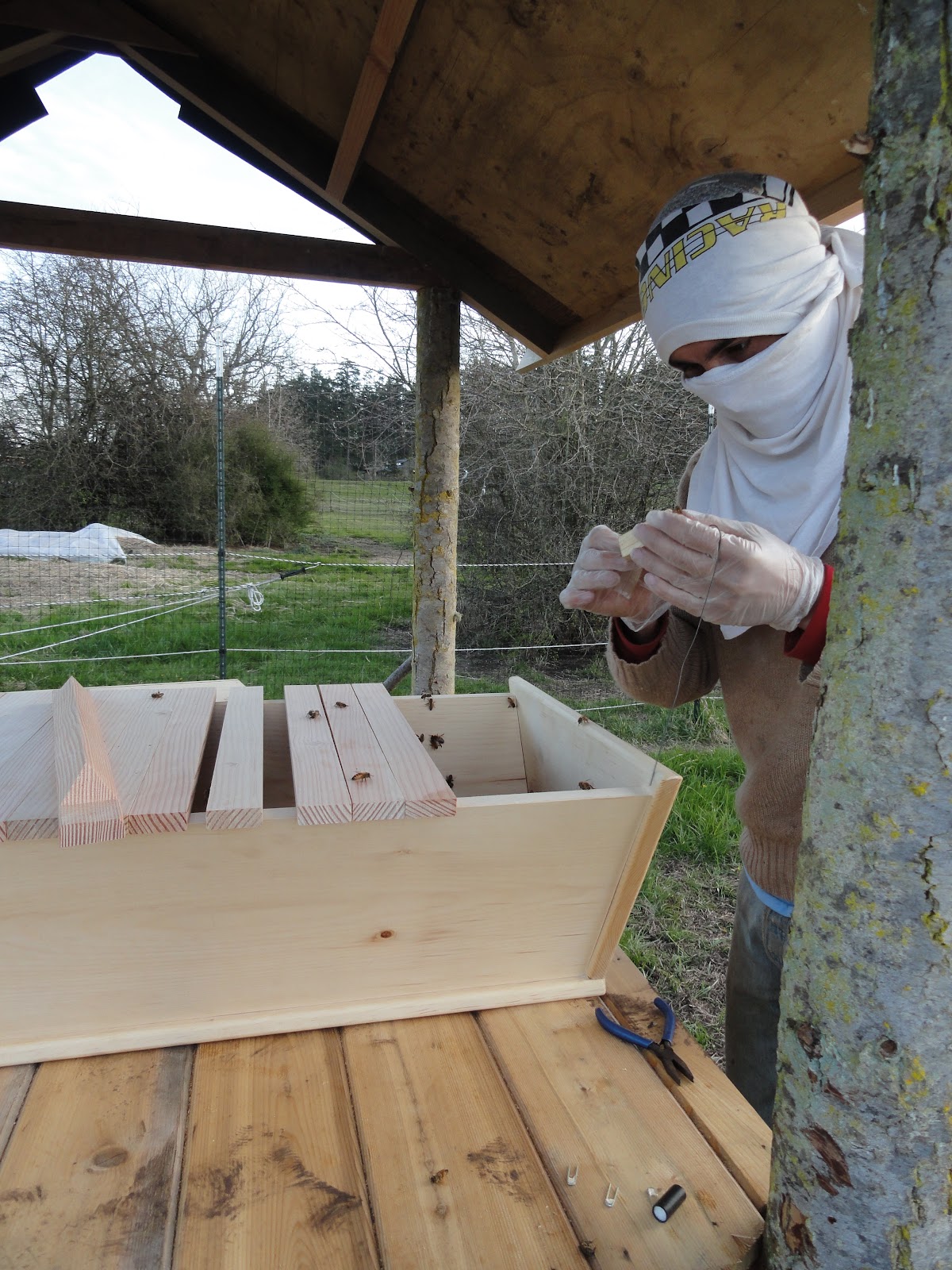
Last Thursday, Heritage became home to two new hives of bees. A dedicated bee keeper for the past few years, Pablo built top-bar style hives for our new insect residents, and is nearly done with the shelter (to elevate the hives above the ground, where they can become damp from morning dew, and protect them from rain). The hives have been particularly active during sun breaks over the past few days, and it has been neat to see honeybees on flowers out in the fields when we are working. Today we planted a bed of flowers next to the hives, ensuring the bees a nearby snacking source come summer.
Pablo opens the box in which the bees arrived, while Jim supervises from a safe distance. "Hiving" the bees provided great on-farm entertainment. Note Pablo's professional bee-keeper outfit.
Once the bees have been shaken into the hive, a small capsule containing the queen is suspended inside. The workers then chew through a small plug made of sugar in the capsule, eventually releasing her.
Jim and Sarah do their best bee impression to make our new residents feel at home.
I couldn't be happier with the breaks of sunshine that have heralded in the spring, particularly because I know the weather report calls for more rain soon. Taking advantage of the opportunity, I snapped some shots of the budding and blossoming happening around the fields.
Flowers!
A cabbage transplant that has been moved outside the hoophouse, one of the first this spring.
Raspberry cane buds, I can taste the berries already.
What spring farm blog posting would be complete without at least one baby animal photo? Meet Millie, a NW farm terrier, and the newest addition to the menagerie. As you can plainly see, she is a fierce guard dog. She doesn't let any stranger onto the farm...without trying to lick their face first.
Greetings everyone, Pablo here.
Of course, my first post will be all about me! I want to shamlessly advertise a new website that my brother designed for me
www.zoeticseed.com It is where I am selling flower seed that I grew and harvested down in Oregon before I moved up here. I
also have a seed rack at our farm stand here, and at Compost It in town.
This is the seed rack at Heritage Farm
I know that you might be uncertain about an "online store" or even seeds in general, seeing as how they are so small and everything. To dispel those fears, check out a few seed starting books such as The Maritime Northwest Garden Guide, The Flower Farmer, and Seed Sowing and Saving, as well as Seed to Seed to prepare yourself for a floral adventure. We are entering the "window of opportunity", where everything is possible to plant, and your acreage is the limit!
Look, these seeds really do work!
Celosia "Pampas Plume"
The flowers shown above are the first "wave" of flower seedlings. I plan on successively sowing several (a regular tongue twister) batches, that way I can provide flowers to our CSA customers and farmstand regulars throughout the season.
I'd like to introduce our new farm intern. She may be small, but she's willing to work outside in inclement weather.
I thought we were done with snow this winter, but turns out I was wrong. Thankfully, we got the carrots weeded and covered up the day before the island turned into a winter wonderland. Two new heated tables are helping keep the seedlings cozy in the greenhouse, and we are engaging in unanticipated indoor activities until the snow lets up. Scrabble anyone?
On the farm, we are interested in working with biodynamic practices. For those unfamiliar with biodynamics, it is an alternative form of agriculture. It could be said to fall into the "beyond organic" category. Biodynamic farmers pay close attention to the timing of their activities, including when they sow seeds and harvest, to ensure the most favorable conditions for their plants and the farm as a whole. For example, Wednesday was a leaf day on the biodynamic calendar, meaning conditions were most favorable to plant veggies that are characterized by leaf growth. So as seen in the picture, Pablo planted cabbage seed that day. Other days on the calendar are denoted as root (e.g. carrots or beets), fruit (e.g. peas or squash) or flower days.
Pablo planting cabbage seed into flats in the greenhouse. You can see our lettuce seedlings and onion sets in the foreground.
Last autumn some greens were transplanted into our hoophouse in hopes they would be able to overwinter. I ventured into the hoophouse yesterday and was pleased to see the small lettuce, mustard greens and kale plants have grown, perhaps spurred on by the lengthening daylight hours. I stocked our farmstand with a few precious bags of salad mix. Maybe someone else is as excited about wintertime lettuce as I am?
Despite some pretty vicious cold-snaps this winter, some greens survived in our hoophouse.
Callie, one of our barn cats, can't stay out of the limelight as I photograph the salad mix harvested from the hoophouse.
We periodically move the chicken coop onto new ground so the ladies have access to fresh grass and all the bugs they can get their beaks on. They have recently taken up residence behind the barn, where they like to take dust baths under parked tractor implements. The roosters seem to like to have a perch from which to crow.
Our egg-laying flock enjoying a winter sun break. Note the "Now (P)laying" sign on the back of the coop, formerly located above the movie listings on the side of an old theater in Seattle.
At the farm, we think it is very important to make every effort to relate to our animals. Below, Pablo is demonstrating one such effort with our Jersey milk cows.
Rose doesn't mind spending some downtime with Pablo, although Daphnie (standing) looks skeptical.
January has brought a few changes to Heritage Farm, namely that Pablo Feliz and myself, Camryn Pennington, have taken over as the new farm managers. We are looking forward to the growing season and have already begun preparations for the garden.
Visitor Jay displays his handiwork, a new worm bin. The worms love to eat our veggie scraps, and we love the compost they produce.
Close-up of our worm bin residents at work.
Early lettuce seedlings growing in the greenhouse.
Available in the farm stand this week:
Brussel sprouts
Potatoes
Garlic
Pork by the piece
Pastured chicken eggs
No, not the kind you put on a cake but the kind that happens after hail!
We went out to harvest carrots and the shear delight of yanking out stuff from the ground with the ground covered in white was a real treat. I grew up in a climate that would not allow this to be happening at this time of year. I hope the punch packed for us tonight and tomorrow don't freeze the shoulders of these little wintertime gems. If these were diamonds they would be more than 12 karats each.
Carrots and sleet
Farmer Scott contemplating the next cold snap
Well, it happened last night. As I was sleeping I heard the first and second (and the only 2) cracks of lightning. It was nice to know that there was something good out there fixing atmospheric nitrogen N2 into available N2O for the soil and plants. Its the hardest thing to make in nature. But then I began to sigh, as I heard the pelleting of hail hitting the roof. "It must be cold out there" I said to the unattentive n sleeper next to me. I wondered what might be happening to all the greens and the cauliflower and the sprouting broccoli plants. But knowing I have no control over it all, I fell back asleep.
I awoke to a winter wonderland of a sheet of frozen together hail balls. It had to be worse than I imagined in my dreams. I suited up and took a walk, after my morning tea, nothing gets me away from that.
The first thing I saw was the pullets (not laying hens) and their white playground. They tend to like the tastey green stuff that grows there but its all gone now.
Then I saw this lonely pumpkin that fell out of the wheel barrow during harvest and has sat there for over a month now. It is a symbol of harvest that greets everyone who enter the garden. I think it might make a great head to a snowman or is that a hailman?
A quick walk around the fields yielded the following results: It hailed and it hailed a lot. Luckily it was small. I hope the plant tissue can handle the cold cause they are now "on ice". And its supposed to be even colder tonight, minus the sleet. What is the difference between sleet and hail anyway?
Lettuce
Beets
Cauliflower
Cabbage

The summer is long gone, its tell tale sign only visible on the calendar and the lack of tomatoes. What makes the tomato such a beloved veggie? Why is it the one thing that farmers try their darndest to get to market first? Why does it draw such great devotion to the subtle variations in tastes and textures? The delicate flavors of a single tomato could be the culprit to such sinister acts as wrecking a home. Many a time I have been at a friends house and saw with my own eyes the fervor that wells inside some over their tomatoes. I myself have such an addiction to these lovely fruits that during the peak of the season I have been known to eat entire meals of juicy tomatoes. A tomato is where I spend my summer vacation. Its very inexpensive and I get to visit every day. Every tomato welcomes me with a floral scent encouraging me to bite in and feel the juice run down my face. One should never attempt to slow or divert the flow with a napkin, a sleeve is acceptable but true etiquette calls for it to drip off ones face.

Like those who enjoy thier BonBons sitting in front of the TV, I find a view of the garden much more relaxing and the commercials (things buzzing about the air) are always louder than the actual program for some reason. I stand and pop those little dots of cherry tomatoes in my mouth, one by one, pint by pint until I am well satiated.
And then there are those times that I find myself actually in the house cooking, with a tomato none-the-less. I made a burger this past summer with everything but the bread from farm raised stuff. It was heavenly, fulfilling and made me take a nap afterwards. I am reliving this day until next year when we have tomatoes on the farm again. I love the seasonality of it all. I can never get sick of one thing because its never around long enough for that to happen. And I have renewed appreciation for what I have lost. May the spirit of the tomato be with us all.
Although we live at roughly the same latitude as the bone chillin' Minnesota or North Dakota, we have an ocean to regulate the temperatures a bit, or a lot! The same ocean that makes it difficult to grow hot season plants here is the same one that makes it possible to grow cold tolerant greens in the winter. In recent years there has been a lot of emphasis put on hoop houses to extend seasons, even in the bone chillin' north. These structures give plants a few degrees protection from frost and cold and also stop the winds that make things freeze faster.

We planted out hoophouse to green things a few weeks ago to some greens we hope make it through the "cold winter" we are supposed to have this year. In there is some lettuce, mustard greens, cabbage, chard, and kale. I would like to keep a few of the survivors and let them seed out. I could then collect the seeds next summer and plant them again in the fall for winter survival. If I do this enough times I will have seeds that are very tolerant to our cold snaps. As of now I use seed that is purchased and not bred for things like cold tolerance. Who knows, maybe soon we will have our own breed of lettuce. And besides, it just plain makes sense for a farmer to start saving his own seed for future use.
Farm Tour season is still in full swing. The other day we received a group of young WSU students wishing to learn more about sustainable agriculture in the PNW. They were given the full round about tour of everything a small, integrated farm has to offer and its many interrelated parts that make it a functioning whole. Its refreshing to offer this insight to the next generation when they are inundated with information that revolves around how large industrial farms operate. They learn the importance of and how to close the loop of inputs and outputs, making a small farm profitable in the newly emerging small farm economy. But it wasn't all seriousness. We set out to get them geared up for their next frightful Halloween by providing them with farm raised pumpkins to carve and eat!
As the season winds down we want to give out a big shout to our CSA members who have supported us throughout the worst growing season in 3 decades! Yea and we hope you all have enjoyed your wonderful variety of veggies and they have nurtured your bodies and souls. We still have 3 more weeks left and you better like root crops and squash! Hope to see you all next year, just a few months away til spring share season...
The piggy named Spike loves to give rides. He actually enjoys when I get on his back. I think its like chiropractic medicine for him and all that wonderful tasty bacon he has to carry around. Mmmmmmm, bacon....
The season has been long and difficult. The worst in 2 decades I am told (depending on who you speak with). But we have harvested the winter squash and have hauled it into the greenhouse to protected it from the coming weather. Its not as huge as expected but at least we have some to eat in the months ahead.
We tore into 3 different varieties and the results are good. They have firm flesh and are sweet. Not as sweet as I had hoped or what I am used to but none the less very tasty. They cooked up nice in the oven, held their moisture and even got a bit flakey near the end. We ate them right out of the shells. Just a bit of salt and butter. Then we made a bit of bread and a whole mess of creamed squash soup.
We put in several varieties but the best ones are sweet meat, baby blue hubbard, and burgess buttercup. Unfortunately these are the ones that produced the least in our wonderful climate. As I have been saying all year long, "there is always next year!"
We hope you enjoy all of them over the next few months...
We are Back! We took a hiatus from this blog due to some big brothers, i.e, the government, having an itch to scratch with our farm. Thanks to a new law put into action earlier this year we can now have apprentices come to the farm and learn all about the wonderful ways of farming without having to spend fifty thousand dollars to go to university. And besides they will get a better curriculum that has loads of hands on learning, eat way better food than in the cafeteria and not have to deal with their dorm mates. We will be growing the new generation of farmers right here on the island and it wont be conventional agribusiness. Nope none of that at all, in fact we will be teaching how to run a business that is small, sustainable, profitable, good for the community, good for the body, bring down the agribusiness giants kind of farming. If your Monsanto, ConAgri, or ADM and your reading this you should be very concerned. The era of behemoth, blue chip monopolies is over. Its time for the synergy of mind, body and spirit to control the food once again.
Potatoes, potatoes, potatoes
And more potatoes
Oh my god, the potatoes are dragging me into the ground!
The fall leeks went in yesterday